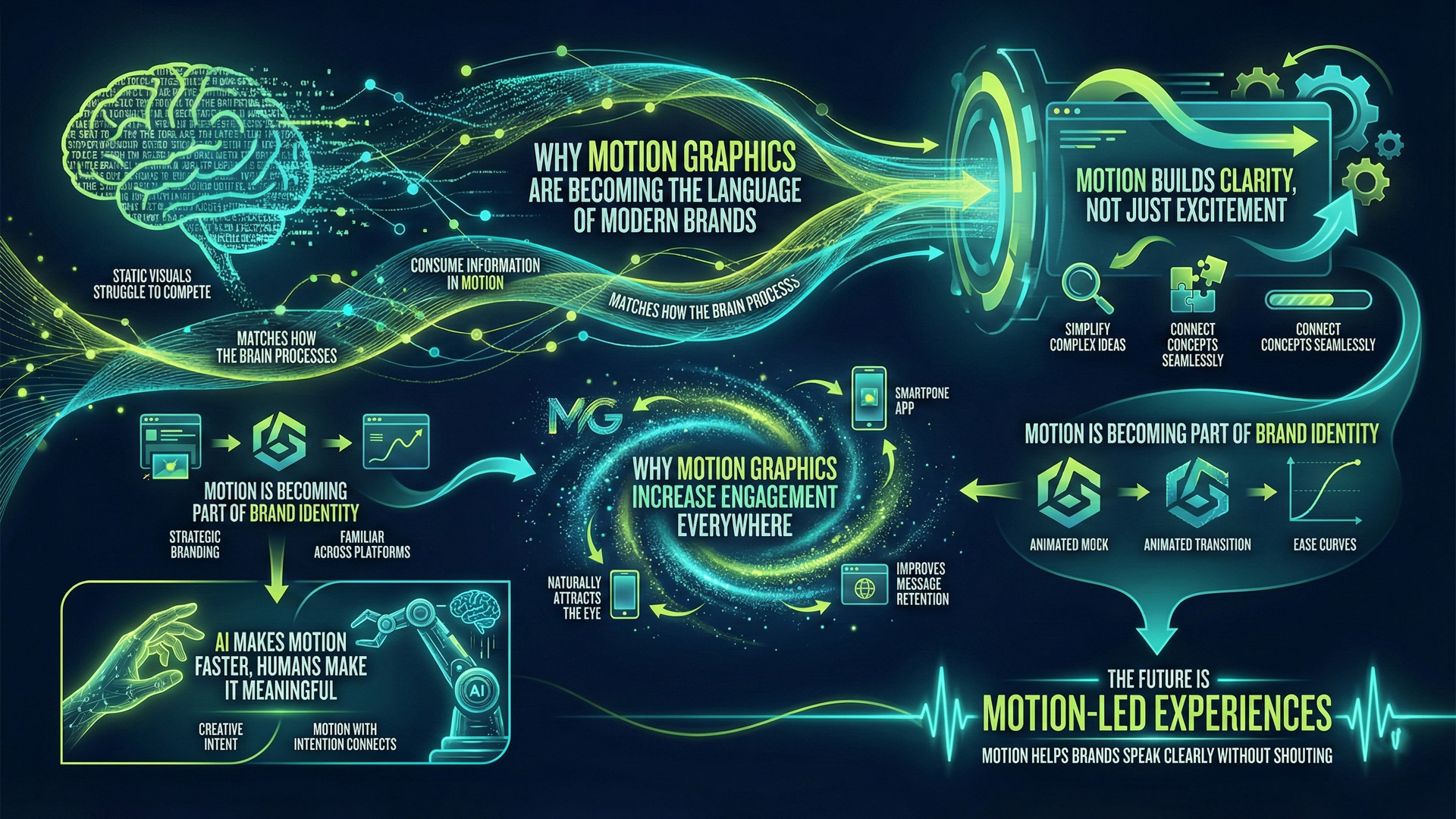
Why Motion Graphics Are Becoming the Language of Modern Brands
Motion graphics are no longer just “nice animations” added at the end of a project.
Right now, they’re becoming the primary way brands communicate ideas quickly, especially in a world where people scroll fast, skip text, and expect instant understanding.
Brands that understand motion are staying relevant.
Brands that don’t are starting to feel static.
We now consume information in motion, not blocks
Think about how people consume content today:
- • short videos
- • animated explainers
- • moving interfaces
- • interactive websites
Static visuals struggle to compete because motion matches how the brain processes information now in sequences, not paragraphs.
Motion graphics help guide attention:
- • what to look at first
- • what matters most
- • what action to take next
This makes them incredibly powerful for storytelling.
Motion builds clarity, not just excitement
One common misconception is that motion graphics exist only to impress.
In reality, their biggest strength is clarity.
Good motion graphics:
- • simplify complex ideas
- • visually explain processes
- • connect concepts seamlessly
- • reduce the need for long explanations
Instead of adding noise, motion removes friction.
Why motion graphics increase engagement everywhere
Motion works because it:
- • naturally attracts the eye
- • keeps users engaged longer
- • improves message retention
- • increases interaction rates
That’s why brands are increasingly using motion graphics across:
- • websites
- • landing pages
- • apps
- • product demos
- • brand videos
- • social content
Motion turns passive viewing into active understanding.
Motion is becoming part of brand identity
A big shift happening right now:
brands are using motion consistently not randomly.
Transitions, animation speed, easing styles, and movement patterns are becoming part of how a brand is recognised, just like colors and typography.
This means:
- • motion is no longer decorative
- • it’s strategic branding
When users feel the same movement style across platforms, the brand becomes familiar even without seeing the logo.
AI makes motion faster, humans make it meaningful
AI tools can generate animations quickly, but without human direction:
- • motion feels generic
- • timing feels off
- • storytelling feels empty
The real value lies in creative intent:
knowing when to animate, how much movement is needed, and when stillness is more powerful.
Motion without purpose distracts.
Motion with intention connects.
The future is motion-led experiences
Websites are becoming more interactive.
Apps are becoming more fluid.
Brands are becoming more expressive.
Motion graphics sit right at the center of this evolution.
Brands that invest in thoughtful motion design aren’t just keeping up, they’re shaping how people experience digital products.
Final thought
Motion graphics aren’t about movement.
They’re about guidance, emotion, and understanding.
In a fast, noisy digital world, motion helps brands speak clearly without shouting.
#MotionGraphics #MotionDesign #BrandExperience #DigitalDesign #VisualStorytelling #CreativeDesign #Roex #RoexDesign