The ROI of Branding: How Design Directly Impacts Revenue
Many businesses still see branding and design as a creative expense.
Something that improves appearance. Something that makes things “look better.”
But not something that directly impacts revenue.
That thinking is outdated.
In today’s competitive market, branding is not just visual.
It is financial.
Because every design decision, from your logo to your website, influences how customers perceive your business, how they trust you, and ultimately, whether they choose you.
Let’s break down how branding delivers real return on investment (ROI).
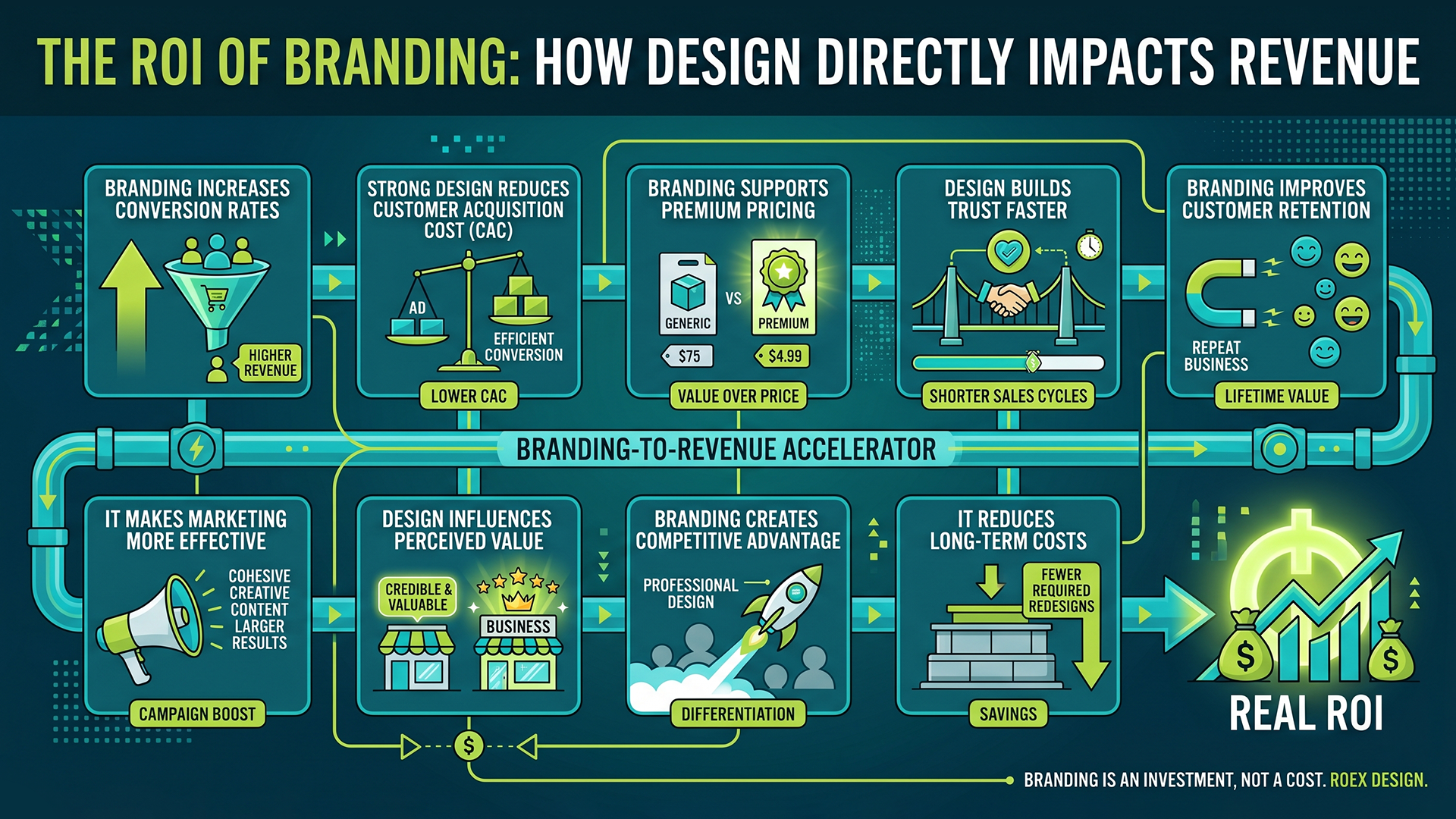
1. Branding Increases Conversion Rates
Your marketing brings traffic.
Your branding converts it.
When a visitor lands on your website, they immediately evaluate:
- • Does this look professional?
- • Can I trust this business?
- • Is this worth my time or money?
Strong branding answers these questions instantly.
Clear structure, cohesive visuals, and strategic messaging create confidence.
Confidence reduces hesitation.
And reduced hesitation increases conversions.
Even small improvements in conversion rate can significantly increase revenue over time.
2. Strong Design Reduces Customer Acquisition Cost
Customer acquisition cost (CAC) is one of the most important business metrics.
If your branding is weak:
- • Visitors don’t convert
- • Leads drop off
- • More ad spend is required
Which increases your cost per customer.
But when branding is strong:
- • More visitors convert
- • Marketing becomes more efficient
- • Less spend is needed to generate results
This means better ROI on every marketing dollar.
3. Branding Supports Premium Pricing
Pricing is not just about what you offer.
It’s about how your business is perceived.
If your brand looks:
- • Professional
- • Structured
- • Premium
- • Consistent
Customers expect higher quality.
And they are more willing to pay for it.
If your brand looks average, customers compare prices.
If your brand looks premium, customers compare value.
That shift directly impacts revenue and profit margins.
4. Design Builds Trust Faster
Trust is one of the biggest drivers of buying decisions.
And design is one of the fastest ways to build it.
Your:
- • Website layout
- • Typography
- • Color system
- • Visual consistency
All communicate reliability.
A well-designed brand feels stable.
A poorly designed brand feels uncertain.
When trust builds faster, sales cycles become shorter.
Shorter sales cycles mean faster revenue generation.
5. Branding Improves Customer Retention
ROI is not just about acquiring customers.
It’s about keeping them.
Strong branding creates:
- • Recognition
- • Familiarity
- • Emotional connection
Customers remember brands that feel consistent and intentional.
And remembered brands are more likely to be chosen again.
Higher retention means:
- • More repeat business
- • Higher lifetime value
- • Stronger long-term growth
6. It Makes Marketing More Effective
Marketing without strong branding is inefficient.
You may get clicks, but not conversions.
You may get attention, but not trust.
When branding is aligned:
- • Ads perform better
- • Content feels more cohesive
- • Messaging becomes clearer
- • Campaigns convert more
Branding amplifies marketing performance.
It turns effort into results.
7. Design Influences Perceived Value
Perceived value is what customers believe your service is worth.
And design plays a major role in shaping that perception.
Two businesses can offer the same service.
But the one with better branding will be seen as:
- • More credible
- • More reliable
- • More valuable
That perception allows you to:
- • Charge more
- • Attract better clients
- • Position yourself above competitors
8. Branding Creates Competitive Advantage
In saturated markets, most businesses offer similar services.
Which means differentiation becomes critical.
Branding creates that difference.
It helps you:
- • Stand out visually
- • Communicate clearly
- • Position strategically
Without strong branding, you compete on price.
With strong branding, you compete on value.
And value-based competition is far more profitable.
9. It Reduces Long-Term Costs
Businesses that ignore branding often face:
- • Frequent redesigns
- • Rebranding expenses
- • Ineffective marketing campaigns
- • Lost opportunities
Investing in strong branding early reduces the need for constant changes.
It creates a stable foundation that supports long-term growth.
Which ultimately lowers overall costs.
Branding Is Not an Expense, It’s an Investment
The biggest shift businesses need to make is this:
Stop viewing branding as a cost.
Start viewing it as an asset.
Because branding impacts:
- • Conversion rates
- • Customer acquisition cost
- • Pricing power
- • Customer retention
- • Marketing performance
At Roex Design, branding and website design are approached with one goal:
To deliver measurable business impact.
Not just visual improvement.
Because when design is strategic, it doesn’t just look better.
It performs better.
Final Thought
Every business wants growth.
But growth doesn’t come from effort alone.
It comes from efficiency.
Strong branding improves how efficiently your business:
- • Attracts customers
- • Converts leads
- • Builds trust
- • Generates revenue
That is the real ROI of design.
And in a competitive market, it’s not optional.