Beyond the Grid: Why Template-Based Design Is Quietly Costing Your Startup Authority
Templates are everywhere.
And that’s exactly the problem.
In a world where startups are fighting for attention, trust, and credibility, template-based design doesn’t just limit creativity, it limits perception.
Most founders don’t realise this early enough. By the time they do, the brand has already blended into the background.
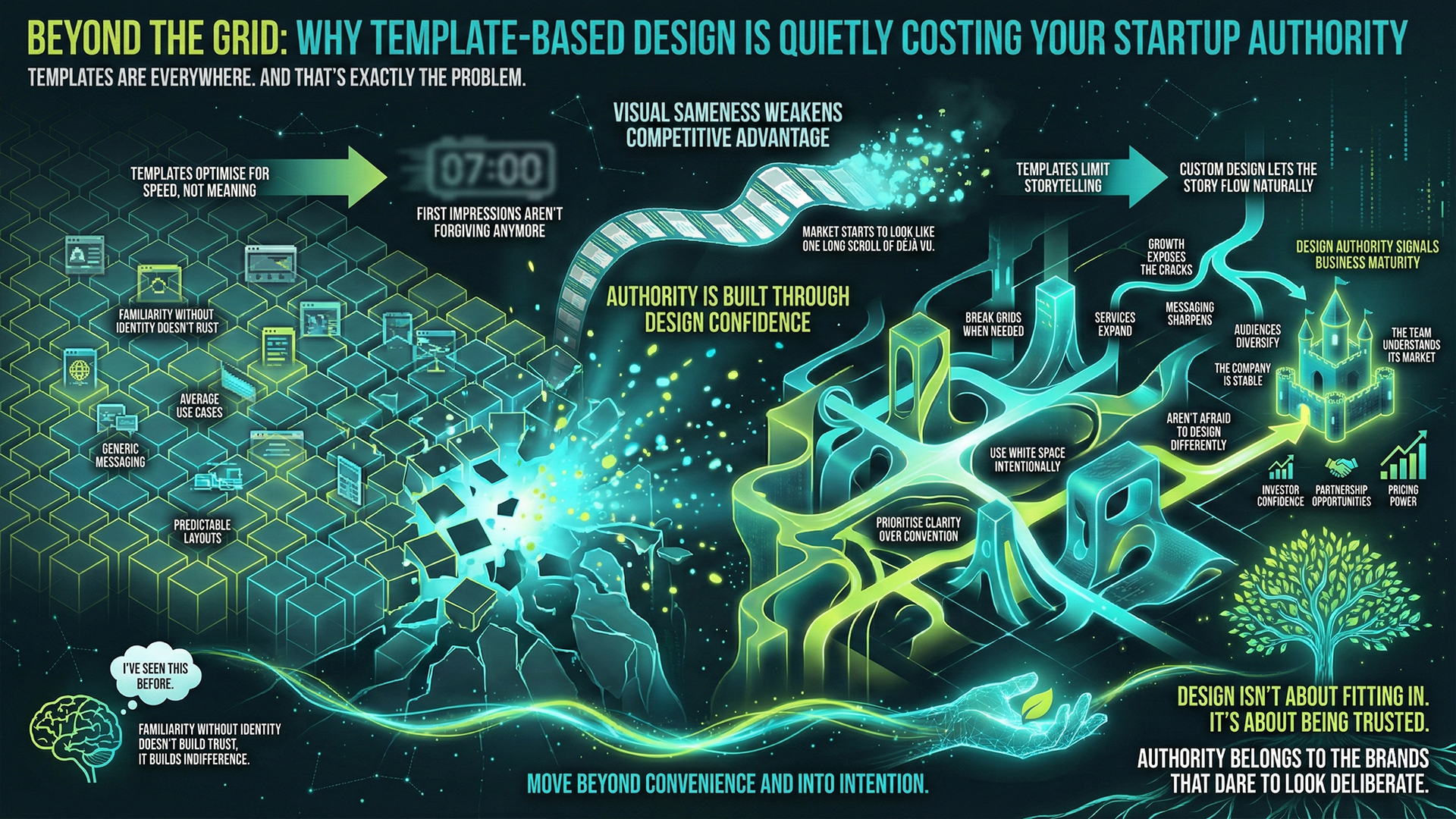
First impressions aren’t forgiving anymore
Today’s users have seen hundreds of websites that look “clean,” “modern,” and “minimal.”
So when your site looks familiar in a way that feels generic, the subconscious response is simple:
“I’ve seen this before.”
And familiarity without identity doesn’t build trust, it builds indifference.
Authority is lost in those first few seconds.
Templates optimise for speed, not meaning
Templates are built to work for everyone.
Which means they are designed for:
- • average use cases
- • generic messaging
- • predictable layouts
But authority brands aren’t average.
They’re specific.
When design doesn’t reflect the personality, positioning, and priorities of your startup, it creates a disconnect between what you say and what people feel.
Visual sameness weakens competitive advantage
When competitors use similar templates, the market starts to look like one long scroll of déjà vu.
Same hero sections.
Same animations.
Same call-to-action placements.
In this environment, the strongest brands aren’t the loudest, they’re the most distinct.
Custom design creates visual memory.
Templates erase it.
Authority is built through design confidence
High-authority brands feel confident visually.
They:
- • break grids when needed
- • use white space intentionally
- • prioritise clarity over convention
- • aren’t afraid to design differently
Templates don’t allow for that confidence. They enforce rules that may not align with your brand’s voice or ambition.
Authority doesn’t come from following patterns.
It comes from owning them, or redefining them.
Templates limit storytelling
Your startup has a story:
- • why it exists
- • what problem it solves
- • what makes it different
Templates force that story into predefined sections.
Custom design lets the story flow naturally, guiding users instead of pushing them.
And brands that tell better stories are remembered longer.
Growth exposes the cracks
At an early stage, templates feel “good enough.”
But as your startup grows:
- • services expand
- • messaging sharpens
- • audiences diversify
the limitations become obvious.
What once felt efficient starts feeling restrictive.
And redesigning later becomes more expensive, both financially and strategically.
Design authority signals business maturity
When people see intentional design, they assume:
- • the company is stable
- • decisions are thoughtful
- • the team understands its market
This perception directly impacts:
- • investor confidence
- • partnership opportunities
- • pricing power
Design doesn’t just support authority, it signals it.
Final thought
Templates are not bad.
They’re just temporary.
The moment your startup wants to be taken seriously, by customers, partners, or investors, it has to move beyond convenience and into intention.
Because in a sea of similar-looking startups, authority belongs to the brands that dare to look deliberate.
Design isn’t about fitting in.
It’s about being trusted.
#StartupDesign #BrandAuthority #DesignThinking #WebDesignStrategy #BrandPositioning #CreativeAgency #Roex #RoexDesign